
How to pick the best Distribution Center Cleaning Services
Forklifts don’t stop for a mop bucket. In a distribution center running multiple shifts, the right distribution center cleaning services work around shipping and receiving, keep walkways safe, and prove the work got done without slowing the dock. To choose a provider in Chicago, compare five things: industrial experience, scheduling flexibility, safety practices, cleaning capabilities, and documented quality control.
Spotless Cleaning Chicago cleans warehouses and distribution centers across Illinois, Indiana and Wisconsin, and Spotless Facility Group is listed with Honors in ISSA’s CIMS directory.
Certified & Compliant: ISSA CIMS with Honors · OSHA trained · $10M insured · BBB A+ · Avetta Safety Star · In business since 2008
Unlike traditional office environments, distribution centers face challenges such as forklift traffic, continuous material movement, dust accumulation, and limited cleaning windows. Under OSHA’s 29 CFR 1910.22, employers must maintain clean, orderly, and sanitary walking-working surfaces and address hazardous floor conditions.
This guide explains what to verify during a facility walkthrough, how to coordinate cleaning around active operations, and how Spotless’s published services and accountability practices address those needs.
What Should You Look for in Distribution Center Cleaning Services?
Choosing a cleaning provider for a distribution center requires evaluating more than pricing and basic janitorial services. The right contractor should understand how cleaning affects warehouse operations, workplace safety, equipment access, and daily productivity.
For Chicago-area logistics and fulfillment facilities, here are five important factors to consider when evaluating distribution center cleaning services.
1. Experience Cleaning Active Distribution Centers
Distribution centers operate differently from traditional commercial buildings. Forklifts, pallet jacks, conveyors, and warehouse personnel frequently share operational spaces, creating cleaning challenges that require careful coordination.
Ask for relevant warehouse or distribution center experience and examples of how the provider planned access to floors, loading docks, and elevated surfaces. Review the provider’s industrial cleaning capabilities against your facility’s actual conditions.
2. Flexible Scheduling Around Warehouse Operations
Ask how the provider will accommodate shipping and receiving peaks, shift changes, overnight work, and maintenance windows. Request a proposed schedule showing which areas can be cleaned during operations and which require restricted access.
3. Safety Practices and Industry Knowledge
Distribution center cleaning introduces potential hazards when employees and cleaning crews work around powered industrial trucks, machinery, and active loading areas.
According to OSHA’s warehousing safety guidance, warehouse environments present hazards involving forklifts, material handling, slips, trips, and falls.
Before hiring a contractor, ask about employee safety training, cleaning equipment procedures, chemical handling practices, and how cleaning teams coordinate with facility personnel.
4. Specialized Cleaning Equipment and Capabilities
Not every distribution center can be properly maintained using standard janitorial equipment.
Depending on the facility, that can mean industrial floor cleaning for high-traffic warehouse floors, high dusting for elevated structural surfaces, loading dock cleaning for busy shipping and receiving areas, equipment cleaning with methods suited to each machine, and periodic deep cleaning for buildup that routine service misses.
Ask prospective cleaning companies which services they perform directly, what equipment they use, and whether they can accommodate the specific conditions of your facility.
5. Quality Control and Service Accountability
A cleaning contractor’s responsibilities should extend beyond completing scheduled tasks. Facility managers should understand how cleaning performance is monitored, how service issues are reported, and who is responsible for resolving problems. Look for clearly documented scopes of work, inspection procedures, consistent communication, and a designated point of contact.
These practices can help distribution center operators evaluate service quality without having to personally oversee every cleaning task.
How Can Cleaning Fit Around Distribution Center Operations?
Distribution center cleaning services should be scheduled and coordinated around a facility’s daily operations. In busy Chicago-area warehouses and fulfillment centers, cleaning activities may overlap with shipping deadlines, receiving schedules, forklift traffic, and employee shift changes.
A well-planned cleaning program considers which areas need attention, when those spaces are available, and whether cleaning equipment or methods could temporarily restrict access.
Coordinate Cleaning Around Shipping and Receiving Schedules
Loading docks, staging areas, and warehouse aisles are essential to daily distribution center operations. Cleaning these areas during peak activity can create unnecessary interruptions or introduce additional safety concerns.
Before setting a cleaning schedule, map out peak hours for shipping, receiving, and order fulfillment; the windows when each area can be reached with fewer conflicts; the high-traffic zones that need more frequent attention; and any restricted areas that require authorization, equipment shutdowns, or coordination with facility staff.
A provider of distribution center cleaning services should understand these operational constraints before recommending a cleaning schedule.
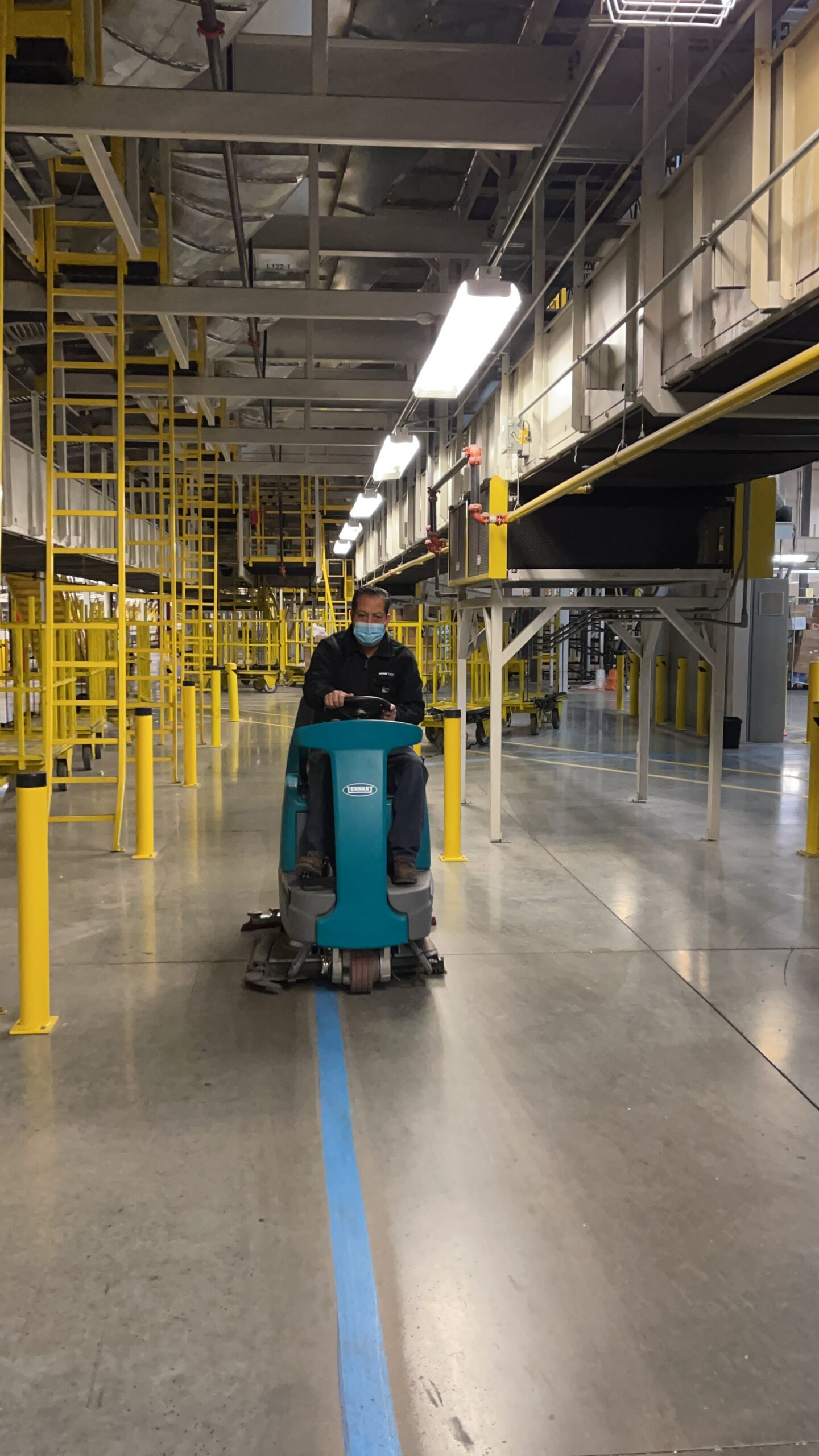
Use Designated Cleaning Zones in Active Warehouses
For distribution centers operating multiple shifts, cleaning an entire facility at once may not be practical.
A zone-based cleaning approach allows facility managers and contractors to organize work by operational area, access requirements, and cleaning priority.
For example, routine cleaning may focus on employee areas and designated warehouse sections, while more intensive industrial floor cleaning takes place during scheduled maintenance windows.
The goal is to coordinate cleaning with operations rather than require operations to accommodate an inflexible cleaning schedule.
Account for Floor Cleaning and Drying Times
Industrial floor cleaning requires careful consideration of the surface material, cleaning method, equipment, and facility traffic.
Depending on the process, certain cleaning activities may leave surfaces temporarily wet or require an area to remain closed until it is safe for use.
Ask prospective providers which cleaning methods suit your warehouse floors, which areas will need to be restricted, how wet surfaces will be marked and protected, how equipment will be coordinated with forklift traffic, and who decides when a cleaned area can safely reopen.
These questions help establish realistic expectations before cleaning begins.
Plan Periodic Deep Cleaning Separately From Routine Maintenance
Not every cleaning task needs to happen daily.
While employee areas, frequently used walkways, and other high-traffic spaces may need regular attention, tasks such as high dusting, industrial equipment cleaning, and intensive floor cleaning may require separate scheduling.
A distribution center cleaning plan should distinguish between routine janitorial services and periodic specialty cleaning based on facility conditions, operational demands, and applicable requirements.
This approach helps operators plan access, equipment availability, and maintenance activities without unnecessarily interrupting daily workflows.
What Safety Standards Should Cleaning Providers Understand?
Distribution center cleaning providers should understand the workplace safety requirements relevant to their work, including walking-working surfaces, powered industrial trucks, and hazard communication. Facility managers should evaluate both employee training and site-specific coordination.
The Occupational Safety and Health Administration (OSHA) identifies warehouse hazards involving forklifts, material handling, and slips, trips, and falls.
Use these three OSHA standards to guide questions about a contractor’s work. The table highlights evaluation topics; it is not a complete compliance checklist.
| OSHA Standard | What Distribution Center Operators Should Evaluate |
|---|---|
| 29 CFR 1910.22 – Walking-Working Surfaces | How the cleaning provider manages spills, debris, wet floors, and temporary access restrictions. |
| 29 CFR 1910.178 – Powered Industrial Trucks | How cleaning crews coordinate with forklift traffic, loading docks, and warehouse personnel. |
| 29 CFR 1910.1200 – Hazard Communication | How cleaning chemicals are labeled, stored, and communicated to employees, including access to safety data sheets. |
These standards address different workplace responsibilities. A cleaning contractor should understand the requirements applicable to its work and coordinate with the facility’s existing safety procedures.
Why Safety Documentation Matters When Hiring a Cleaning Contractor
Facility managers should ask prospective cleaning providers about employee training, site-specific safety procedures, and how potential hazards are communicated before work begins.
A contractor should also be able to explain how it coordinates cleaning activities around active equipment and restricted areas.
Hiring a cleaning company does not automatically make a distribution center OSHA-compliant. However, selecting a contractor that understands relevant safety requirements and follows documented procedures can support a facility’s broader workplace safety efforts.
Why Choose Spotless for Distribution Center Cleaning in Chicago?
Spotless distribution center cleaning services combine industrial cleaning capabilities with site-specific planning and documented quality checks. The Spotless industrial cleaning program addresses shift coordination, warehouse floor care, and geofencing, while its commercial cleaning program describes photo-verified inspections and service alerts.
Spotless Cleaning Chicago provides commercial and industrial cleaning services for warehouses, distribution centers, and manufacturing facilities in Chicagoland. A facility assessment establishes the work scope and scheduling requirements.
Spotless has been in business since 2008, has served 2,500+ facilities, and brings 50+ years of combined experience. It carries a $10M insurance policy, holds a BBB A+ rating and Avetta Safety Star, and has a 4.9 rating from 100+ reviews.
Industrial Cleaning Services for Warehouses and Distribution Centers
Distribution centers often require a combination of routine janitorial services and specialized industrial cleaning.
Spotless distribution center cleaning services address different areas of a logistics facility, including:
- Industrial floor cleaning: Cleaning warehouse and production floors exposed to equipment traffic, dust, and debris.
- High dusting and ceiling cleaning: Addressing dust accumulation on beams, joists, and accessible overhead surfaces.
- Loading dock cleaning: Cleaning shipping and receiving areas exposed to frequent vehicle and material movement.
- Industrial equipment cleaning: Cleaning applicable equipment surfaces based on facility requirements.
- Commercial janitorial services: Maintaining restrooms, breakrooms, offices, and employee common areas.
- Specialty cleaning and floor improvements: Supporting additional facility needs through services such as intensive cleaning and epoxy flooring.
Cleaning requirements vary by facility. A site walkthrough helps determine which services, methods, and scheduling arrangements are appropriate for the property.
Documented Cleaning Quality and Accountability
For buyers of distribution center cleaning services, quality isn’t just about how a facility looks after a service visit. It also involves knowing whether scheduled work was completed and how concerns are addressed.
Spotless backs its work with geofenced clock-ins that verify crews are on site, photo-verified inspections that supervisors use to document quality, alerts related to missed shifts, and cleaning scopes built around each facility’s operating requirements.
These measures provide facility managers with greater visibility into service delivery and help establish clearer expectations between the facility and its cleaning provider.
ISSA CIMS with Honors Certification
The ISSA CIMS directory lists Spotless Facility Group with Honors. CIMS certification assesses a cleaning organization’s management systems through an independent assessment; it is a credential buyers can verify when comparing providers.
CIMS covers management systems including quality, service delivery, human resources, and health, safety, and environmental stewardship. ISSA states that certification requires meeting 100% of mandatory elements and 60% of recommended elements in each section. These are certification requirements, not facility-specific cleaning performance scores.
For operators comparing distribution center cleaning services, certification provides an additional way to evaluate a company’s management practices beyond pricing and service descriptions.
One Provider for Multiple Facility Maintenance Needs
Distribution centers may need more than ongoing janitorial services. Industrial floor cleaning, overhead dust removal, painting, and floor coating projects can require different equipment, scheduling, and coordination.
Spotless Facility Group, the facility-services side of the same Spotless team, offers additional facility services beyond routine cleaning, allowing operators to explore multiple maintenance needs with a single provider.
For logistics and fulfillment operations, this can simplify vendor coordination when a project involves several related services.
The appropriate scope depends on the facility’s condition, operational requirements, and maintenance priorities.
Distribution Center Cleaning FAQs
Distribution center cleaning frequency depends on facility size, operating hours, equipment traffic, dust accumulation, and the type of materials being handled. High-traffic areas, restrooms, and employee spaces may require daily cleaning, while high dusting, industrial floor cleaning, and other specialty services can be scheduled periodically based on facility conditions.
A walkthrough for distribution center cleaning services can help determine an appropriate maintenance schedule.
Distribution center cleaning services typically include a combination of warehouse floor cleaning, loading dock cleaning, high dusting, restroom sanitation, breakroom cleaning, and general janitorial maintenance.
Industrial equipment cleaning and periodic deep cleaning may require a separate scope. Floor coatings, including epoxy installation, are facility improvement projects and should be specified and priced separately from routine cleaning.
The exact scope should be established during a facility walkthrough and documented in the cleaning agreement.
Yes, some tasks can be completed during operating hours when the facility approves safe access and crews coordinate with shipping, receiving, and pedestrian traffic. Work that restricts access may need a separate maintenance window.
However, activities involving wet floors, heavy cleaning equipment, elevated work, or restricted access may require designated cleaning zones or scheduled maintenance windows. Cleaning schedules should be developed around the facility’s operational and safety requirements.
The cost of distribution center cleaning services in Chicago depends on several factors, including facility square footage, cleaning frequency, operating schedules, floor conditions, and the services required.
Spotless’s industrial cleaning pricing approach also accounts for walking distances, dirt levels, facility density, and logistical requirements. Square footage alone does not describe the full workload.
For an accurate estimate, request a distribution center cleaning walkthrough and a proposal that identifies the areas, tasks, frequency, access requirements, and inspection expectations.
Warehouse cleaning and distribution center cleaning share many tasks, including floor cleaning, dust removal, and janitorial maintenance. The practical difference is the site’s operation: shipping volume, material movement, automation, and shift patterns determine when and how areas can be cleaned. These conditions can occur in either type of facility.
Cleaning programs should account for these activities when determining service schedules, equipment requirements, and access to operational areas.
Distribution center cleaning contractors should follow applicable workplace safety requirements and the facility’s site-specific procedures. Relevant considerations include forklift traffic, pedestrian walkways, chemical handling, wet floor management, equipment operation, and restricted work areas.
When comparing distribution center cleaning services, facility managers should ask contractors about employee training, safety documentation, and their procedures for coordinating cleaning activities around active warehouse operations.
Yes. Spotless provides both routine janitorial maintenance and specialized industrial cleaning, so its distribution center cleaning services can cover restrooms and breakrooms as well as warehouse floors, loading docks and overhead areas.
For example, Spotless Cleaning Chicago’s industrial cleaning services include capabilities relevant to warehouses and distribution centers, while Spotless Facility Group, part of the same Spotless team, offers additional facility maintenance services.
Working with a provider that offers multiple services may simplify vendor coordination, depending on the facility’s needs and the provider’s capabilities.
During a distribution center cleaning walkthrough, facility managers should discuss the property’s operational schedule, high-traffic areas, cleaning challenges, safety requirements, and expectations for service quality.
Important questions include:
- What cleaning services are recommended for our facility?
- How will cleaning be coordinated with shipping and receiving schedules?
- What equipment and cleaning methods will be used?
- How are employee training and safety procedures documented?
- How will completed work be inspected and verified?
- Who will be responsible for communication and resolving service issues?
A walkthrough should result in a clearly defined cleaning scope that reflects the facility’s operational requirements.
Plan Your Distribution Center Cleaning Walkthrough
Discuss your operating schedule, facility layout, floor conditions, and hard-to-reach areas with Spotless. A walkthrough helps establish which tasks belong in routine service, which need separate scheduling, and how completed work will be reviewed.
Request a walkthrough for your distribution center or call (312) 488-1113. Have your approximate facility size, shift schedule, and priority cleaning concerns ready.
Sources
- ISSA: CIMS certified organizations and certification criteria
- OSHA: 29 CFR 1910.22, walking-working surfaces
- OSHA: 29 CFR 1910.178, powered industrial trucks
- OSHA: 29 CFR 1910.1200, hazard communication
- OSHA: Warehousing overview
- Spotless: Industrial cleaning services and pricing considerations
- Spotless: Commercial cleaning quality assurance and onboarding